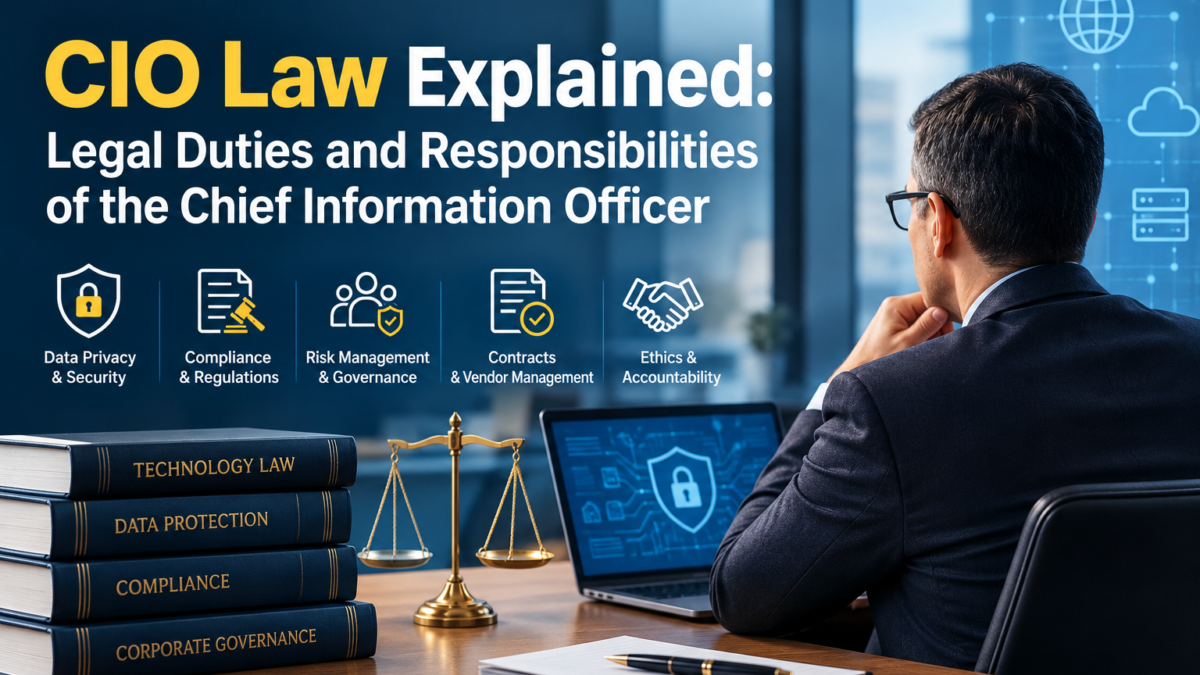
Search for CIO law and you will find a mix of government statutes, executive orders and corporate compliance advice. That is because the phrase has no single official definition. In practice, it points to the legal rules that shape what a chief information officer must do, report and protect. This guide explains the main sources of those rules, who they apply to, and how technology leaders can stay on the right side of them. It is general education, not legal advice.
Quick answer: No single statute governs the role. A chief information officer’s legal duties come from federal laws for government agencies, privacy and security rules, contracts, and company governance.
What Does CIO Law Mean?
The term is informal.Because that role touches data, security, spending and records, many different legal sources can apply to it.
Common sources include:
- Federal statutes that define the CIO role in government agencies
- Executive orders and guidance from bodies such as the Office of Management and Budget
- Privacy, data protection and cybersecurity rules that apply to the data a CIO oversees
- Contracts and corporate governance that set duties inside a company
- Institutional rules, such as a German university statute that makes the CIO a representative of the university leadership, appointed by it uni-muenster
The right source depends on where the CIO works: a federal agency, a private company, a university, or another country entirely.
Key U.S. Federal Rules for Agency CIOs
From the Paperwork Reduction Act to Clinger-Cohen
The role has a legislative history. According to a Congressional Research Service report, Congress required each agency to designate a senior official to oversee information resources through the Paperwork Reduction Act of 1980, and that position was later renamed chief information officer. The Government Accountability Office notes that federal law, particularly the Clinger-Cohen Act of 1996, defined the CIO as the focal point for information technology in agencies. legistormgao
40 U.S.C. §11315
The key provision today is 40 U.S.C. §11315, which covers the agency CIO. For covered agencies, it provides that the CIO has information resources management duties as their primary duty. Federal guidance adds that the CIO serves as the primary strategic advisor to the agency head on the use of IT. govinfocio
Executive Order 13833
In May 2018, an executive order titled Enhancing the Effectiveness of Agency Chief Information Officers reinforced these responsibilities, directing agency heads to take steps that emphasize CIO duties and authority.
Reporting Lines
The law also addresses who a CIO answers to That review dates from 2011, so check current practice before citing it. gao
Legal Issues for Private-Sector CIOs
In business, CIO law is less about one statute and more about a set of overlapping obligations. Typical areas include:
- Data privacy: laws governing how personal data is collected, stored and shared
- Cybersecurity and breach response: security standards and notification duties after an incident
- Contracts and licensing: vendor agreements, software licenses and service-level terms
- Records and retention: keeping, protecting and deleting information as required
- Governance and oversight: reporting risks to executives and the board
Personal exposure is a common concern. InformationWeek reports that companies typically provide top executives with liability insurance, but many CIOs wrongly assume it protects them fully, and there are exceptions. A CIO should confirm the details of any coverage with company counsel rather than assume. informationweek
Practical Examples
These are simplified illustrations, not real cases.
- A federal agency CIO is asked to approve a major IT purchase. Because federal law makes information resources management a primary duty, the CIO needs a documented role in planning and oversight rather than just a signature at the end.
- A company CIO learns that a vendor’s system holding customer data was breached. The CIO must work with legal and security teams to check contract terms, notification deadlines and regulator expectations quickly.
How CIOs Can Stay Compliant
- Know your jurisdiction. Identify which laws and regulators apply to your organization and its data.
- Work closely with legal counsel. Treat the legal team as a partner, not a last-minute checkpoint.
- Document decisions. Written records show how and why choices were made.
- Review vendor contracts. Check security, data handling and liability terms before signing.
- Test your incident response. Practice makes notification and recovery faster.
- Review coverage. Ask what insurance and indemnification actually cover.
Frequently Asked Questions
Is CIO law one statute?
No. It is an informal label for the many laws, regulations and policies that affect a chief information officer. In U.S. federal agencies, 40 U.S.C. §11315 is the central provision.
Who does a federal agency CIO report to?
Federal law requires direct reporting to the agency head, though practice has varied. Check current agency policy.
Can a CIO be personally liable?
It depends on the facts, the jurisdiction and the organization’s governance. Liability insurance may help but does not cover everything, so consult a qualified attorney.
Do these rules apply outside the United States?
Not directly. Other countries and institutions have their own laws, such as university statutes or national data protection rules.
Conclusion
Understanding CIO law means knowing where your obligations come from: statutes for federal agencies, privacy and security rules for data, and contracts and governance for private organizations. Start with the rules that apply to your sector, document your decisions, and bring in legal counsel early. For anything high-stakes, rely on primary sources and qualified professionals.
Editorial note
- Word count: about 1,150 words, estimated. I did not use a counter tool, so please run it through your editor’s word count.
- Exact focus-keyword count: “CIO law” appears 6 times: the title, the introduction, the “What Does CIO Law Mean?” heading, the private-sector section, the first FAQ question, and the conclusion. I avoided the plural form and added no related terms of the same phrase.
- Related keywords: you gave “cio law” for both questions, so I used related terms instead: chief information officer, 40 U.S.C. §11315, Clinger-Cohen Act, Executive Order 13833, data privacy and cybersecurity compliance.
- Facts to verify before publishing:
- The GAO reporting-line finding is from 2011. Check whether current law and practice still match.
- Confirm the current text of 40 U.S.C. §11315 and the status of Executive Order 13833 on official sources such as Cornell’s Legal Information Institute, the Federal Register and CIO.gov.
- The liability-insurance point comes from a trade-press article (2024), not a legal authority.
- I did not cover state, international or sector-specific rules (such as healthcare or finance) in detail.
- If “CIO law” meant something else, such as a Congress of Industrial Organizations labor-law topic or a specific firm called CIO Law, tell me and I will rewrite it.